Zum Hauptinhalt springen

Critical raw materials

Scandium: From Soviet secret to Chinese monopoly

DUE TO THE POTENTIALLY HIGH DEMAND FOR CLIMATE TECHNOLOGIES SUCH AS THE HYDROGEN INDUSTRY, THE WEST IS STRIVING TO PRODUCE ITS OWN SUPPLY OF THIS EXPENSIVE RARE EARTH METAL. THE AEROSPACE AND AUTOMOTIVE INDUSTRIES COULD BENEFIT FROM A SECURE AND AFFORDABLE SUPPLY OF SCANDIUM.

] 
One Week Ago: Second Trialogue Meeting in Brussels on the Critical Raw Materials Act

A week ago, the second trilogue meeting on the Critical Raw Materials Act took place in Brussels — the law designed to secure European industry’s access to critical metals. In today’s highly tense geopolitical climate, Europe’s dependence on just a handful of countries poses a significant risk to its economy.

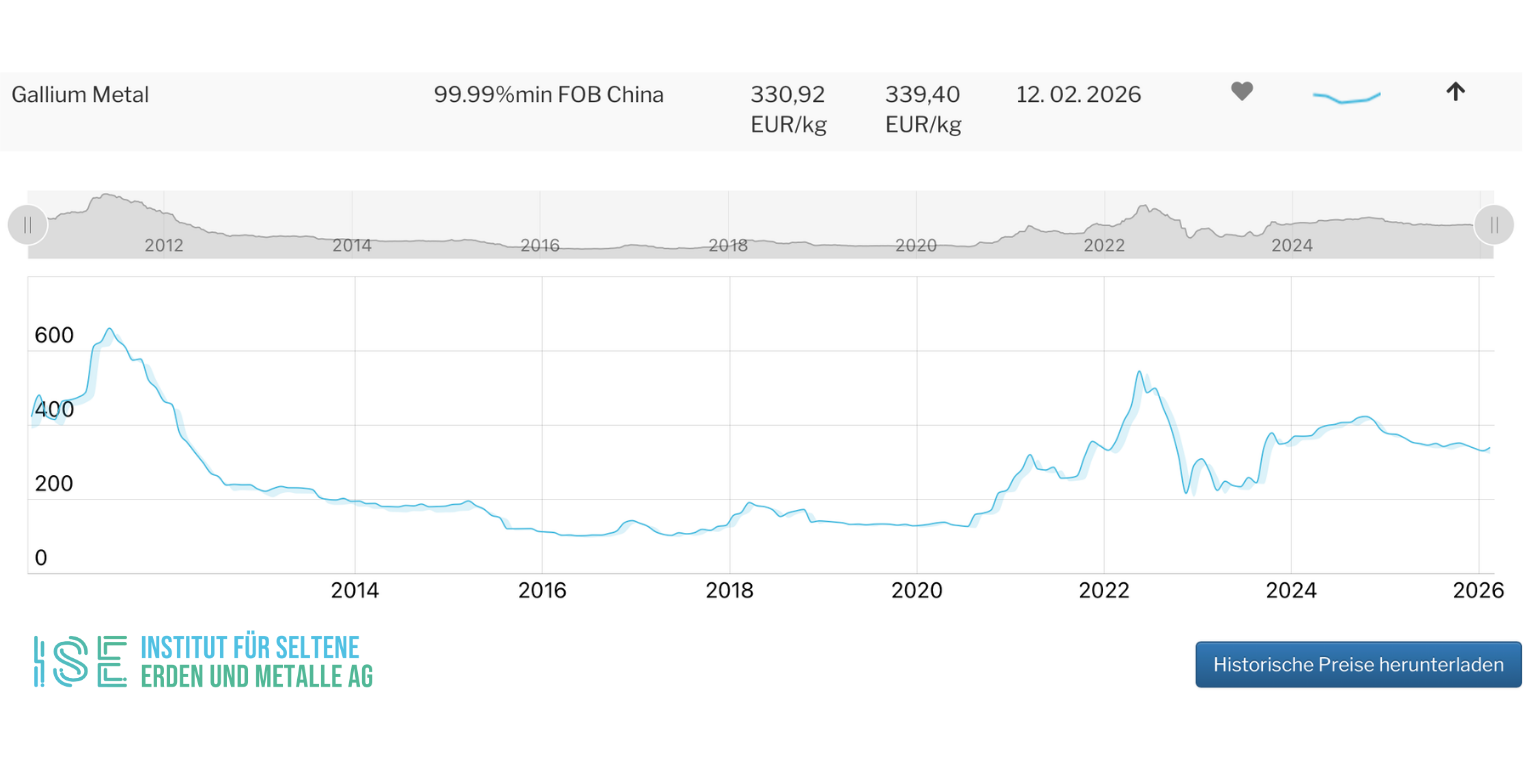
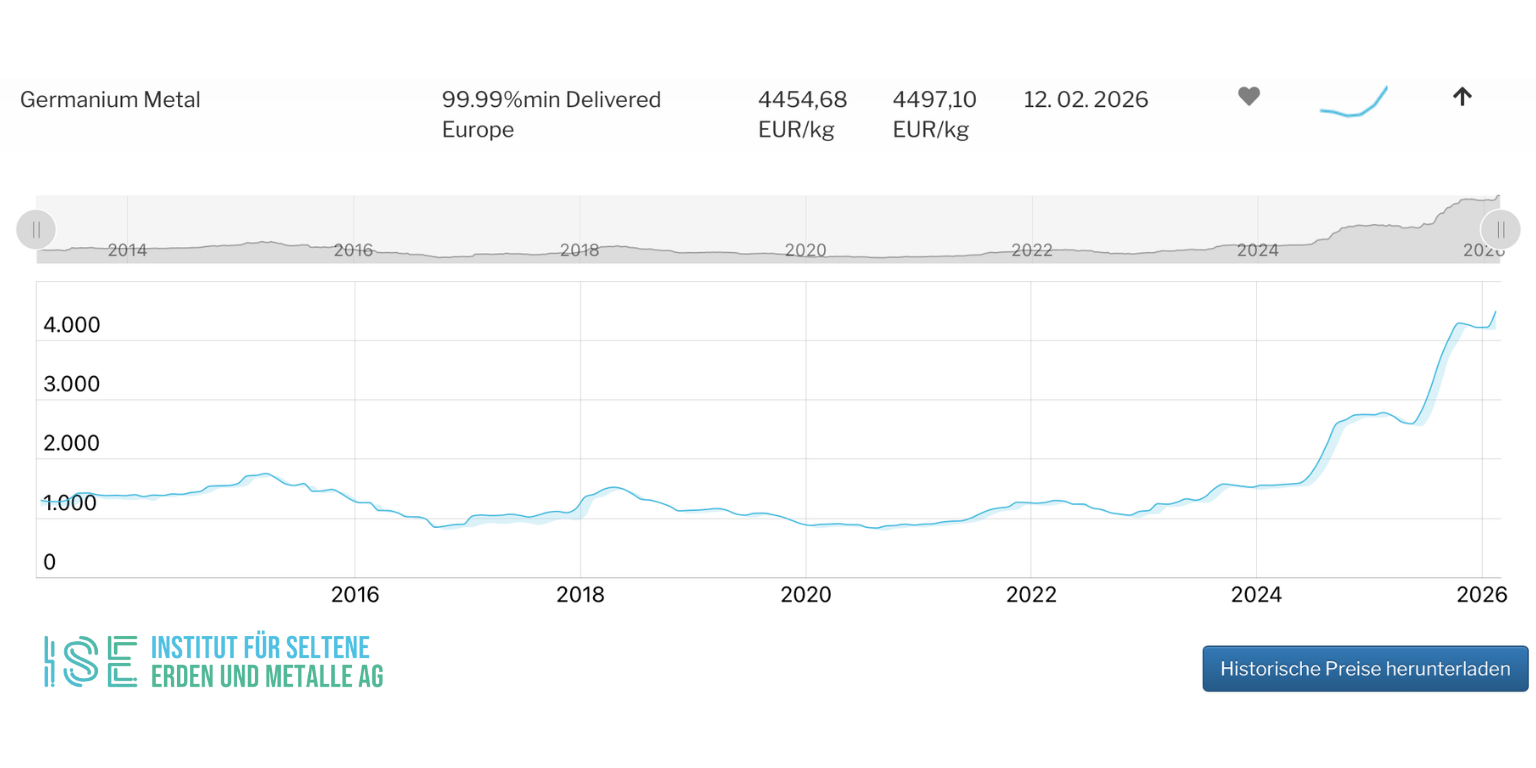
China, in particular, controls both the extraction and processing of many critical and strategic metals, while Russia also plays a dominant role in the raw materials sector. That China is using its monopoly strategically has become evident through its export controls on the technology metals gallium and germanium (see Institut für Seltene Erden).

Now, China has expanded export restrictions to include graphite, the main component of electric vehicle batteries(lithium-ion accumulators).

Scandium: Another Possible Target for Export Controls

According to Alastair Neill from the Critical Minerals Institutescandium could be the next metal subject to Chinese export restrictions.

Despite being relatively common in the Earth’s crust, scandium rarely occurs in concentrated form, which makes dedicated mining uneconomical. Instead, it is typically recovered as a by-product of cobalt, nickel, titanium, uranium, or zirconium mining.

Scandium Production in China: A Black Box

Like gallium and germanium, scandium is a niche metal with a very small global market. Only a few countries supply it — China, Russia, Kazakhstan, and, before the outbreak of war in 2022, Ukraine — producing an estimated 15 to 25 tonnes per year, according to the U.S. Geological Survey (USGS).

Precise figures are unavailable; the market is too small and its uses too fragmented, according to a report from the U.S. International Trade Administration. The actual production volume in China is unknown, particularly for scandium produced for domestic consumption rather than export.

Russia is also believed to still possess Cold War-era stockpiles. What is certain, however, is that China dominates the scandium market.

Aluminum–Scandium: Weight Reduction for Aerospace

Scandium has long been considered highly attractive for industry, with experts predicting a boom for years — yet it has not materialized.

When used as an alloying element in aluminum, even in small quantities (about 0.2%), scandium allows welding instead of riveting of aluminum parts. This enables weight reductions of 10–15%, which is particularly valuable in the aerospace industry, where every kilogram saved translates into hundreds of liters of fuel and significant cost savings.

However, scandium’s high price and supply risks have discouraged major manufacturers such as Airbus from adopting it.

According to data from the Institute for Rare Earths and Metals AG (ISE AG):

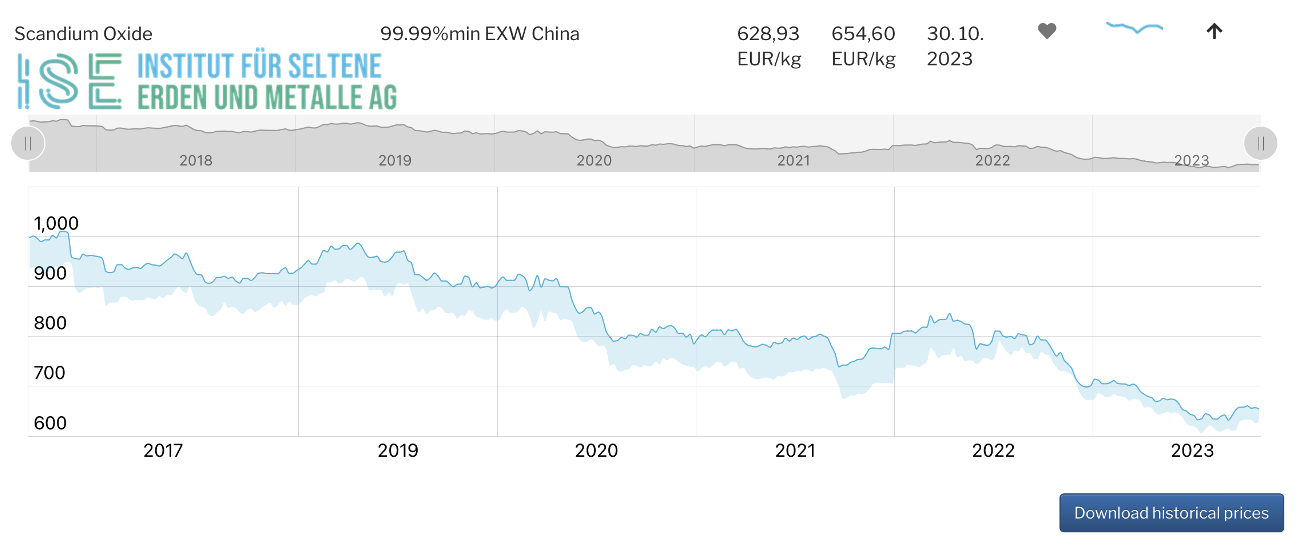
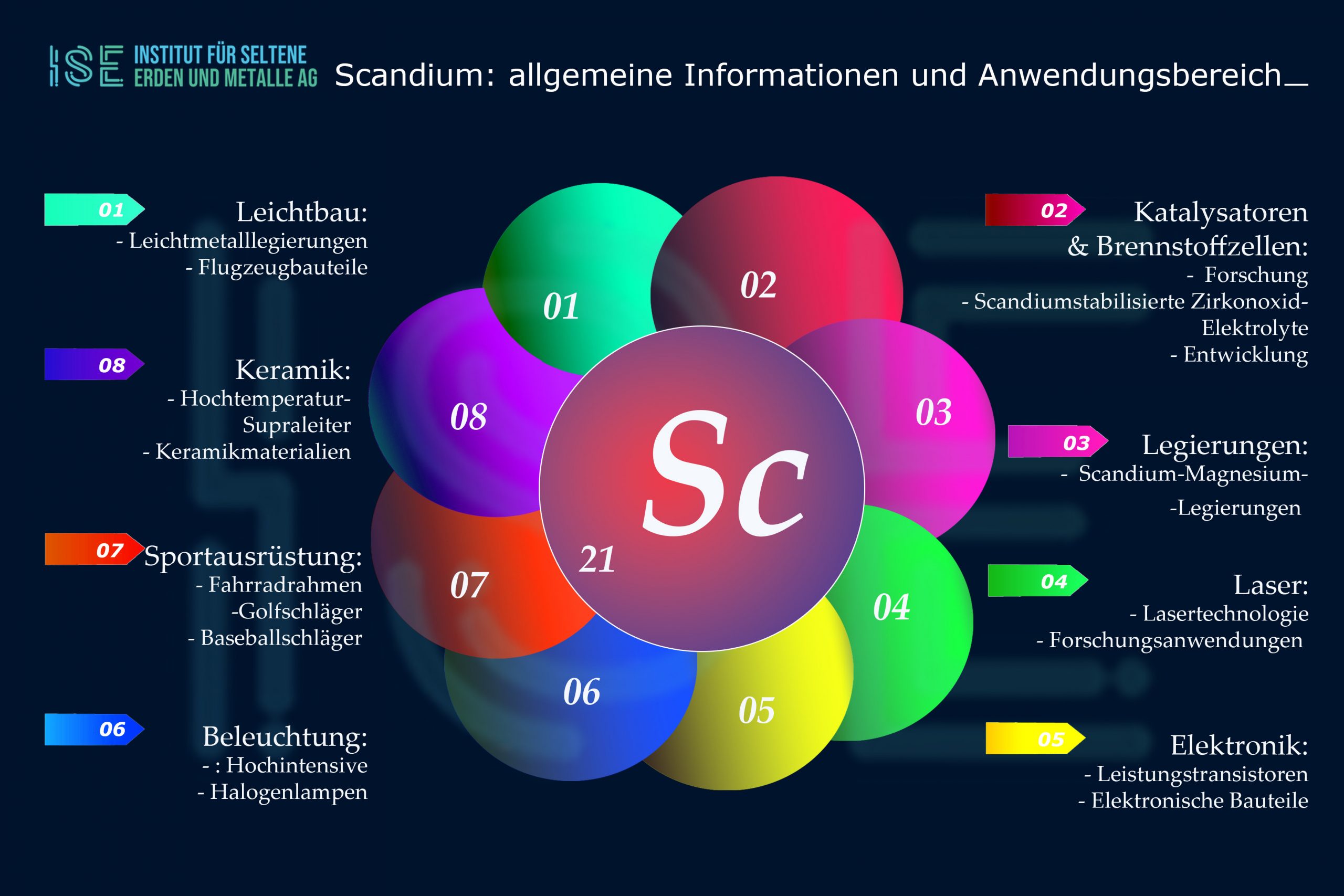
  • Scandium oxide (99.99%): €654.60 (EXW China)
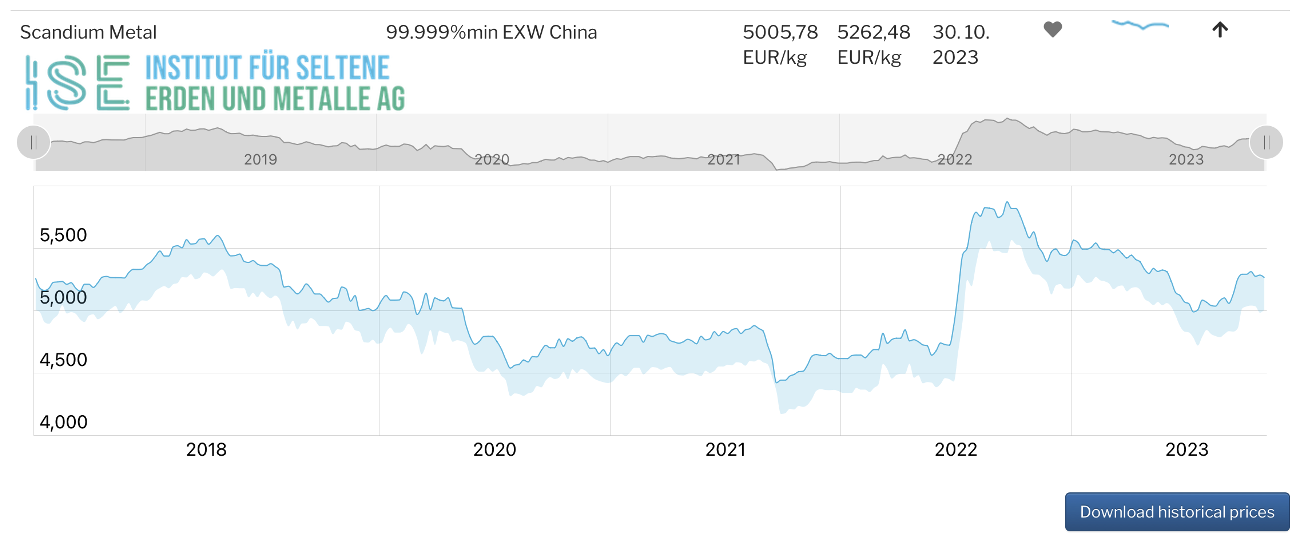
  • Scandium metal (99.999%): €5,260 (EXW China)

Market analysts describe the situation as a “chicken-and-egg problem”: because supply is too limited and unreliable, industrial demand remains low — and vice versa.

A Soviet Secret

Scandium’s unique properties — enhancing strength, flexibility, heat resistance, and corrosion protection — made it a closely guarded secret in the Soviet Union during the Cold War.

As early as the 1950s, Soviet researchers discovered scandium’s ability to improve aluminum alloys. It was first used in the MiG-29 fighter jets, and until the 1990s, the Soviet Union was the world’s largest scandium producer, primarily recovering the metal from uranium mines.

 S

andium Metal 99,9


Rusal ist Marktführer

Auch heute noch ist Russland in Sachen Scandium ein bedeutender Player und dies nicht nur was die Gewinnung angeht. Dem Aluminiumkonzern Rusal ist es als erstem Hersteller gelungen, Scandiumoxid wirtschaftlich aus Rotschlämmen zu gewinnen. Rusal ist auch Pionier bei der Entwicklung von Scandium-Aluminium-Technologien. Laut Maven Research ist der drittgrößte Aluminiumhersteller, dessen schillernder Begründer Oleg Deripaska auf westlichen Sanktionslisten gelistet ist, gar Marktführer für Scandium-Aluminium-Produkte. Auch der Konzern selbst kam 2018 auf die US-Sanktionsliste, wurde nach Umstrukturierungen der Eigentümerschaft Anfang 2019 aber wieder entfernt.

Der Konzern muss wegen Russlands Krieg gegen die Ukraine weiterhin mit Sanktionen rechnen, auch wenn sich Metallhändler und Banken auf der Londoner Metallbörse LME seit kurzem wieder kräftig mit russischem Aluminium eindecken. Viele westliche Unternehmen vermeiden aber auch ohne Sanktionen Geschäfte mit Rusal. Das Unternehmen wendet sich daher verstärkt asiatischen Märkten zu und hat dabei Chinas E-Autoindustrie im Visier, deren Hunger nach CO2-reduziertem Aluminium kräftig wächst.

Scandium in Elektrolyt

Der aktuell größte Einzelabnehmer von russischem Scandium kommt jedoch aus einer ganz anderen Ecke: der kalifornische Brennstoffzellenhersteller Bloom Energy setzt das Element dem Elektrolyt in seinen Festoxidbrennstoffzellen bei. Verwendet wird Scandium in geringen Mengen auch in der Sportartikelbranche, wo es in Fahrradrahmen, Lacrosse- und Baseballschläger stärkt. Auch in Kleinschusswaffen wird es verbaut. Das größte Potenzial für Scandium sehen Marktbeobachter jedoch in der Autoindustrie, die bislang eben wegen der hohen Kosten und des mangelnden Angebots die Finger von Aluminium-Scandium-Legierungen ließ. 

Deutschland: Nachfrage aus der Wasserstoffindustrie

Auch für die Wasserstoffindustrie könnte das Metall wichtig werden. Grün, also mit erneuerbaren Energien, hergestellter Wasserstoff macht derzeit weniger als ein Prozent (40 Terawattstunden) der weltweiten Produktion aus. Die Nachfrage wird künftig extrem steigen. Laut einer Studie der Deutschen Rohstoffagentur (Dera) gehört die Zukunft der grünen Wasserstofferzeugung mittels Wasserelektrolyse, bei der das Gas aus Wasser hergestellt wird. Demnach seien heute drei Elektrolysetechnologien von Bedeutung, von denen die Alkalische Elektrolyse und zu weiten Teilen die Polymerelektrytmembran-Eletrolyse in einem technisch ausgereiften Zustand sind. Die Festkörperoxid-Elektrolyse befindet sich gerade im Übergang zwischen Forschung und industrieller Anwendung.

Allein bei letzterer kommt Scandium zum Einsatz: Der Festelektrolyt besteht entweder aus einem Yttriumdotierten  oder einem Scandium-dotierten Zirkoniumdioxid. Die Vorteile des Scandium-dotierten Materials sind laut Dera die bessere Leitfähigkeit und die höhere Stabilität bei niedrigeren Betriebstemperaturen. Für Scandium sagt die Dera-Studie in einem nachhaltigem Zukunftsszenario bis zum Jahr 2040 einen Bedarfsanstieg auf 24 Tonnen, also das 2,7-fache der Produktion von 2018 (7 Tonnen), voraus.

Rio Tinto setzt auf Scandium

Seit einigen Jahren bemüht sich eine Reihe westlicher Firmen darum, Abbau und Herstellung von Scandium in die eigene Hand zu nehmen. Das könnte ein Zeichen für einen Durchbruch in einigen Jahren hinweisen. Riotinto, ein Schwergewicht unter den Bergbauunternehmen, gewinnt Scandiumoxid seit 2022 aus Abfällen, die bei der Titaniumoxid-Produktion im kanadischen Quebec anfallen. Die Produktionskapazität soll drei Tonnen pro Jahr betragen, was laut Rio Tinto in etwa 20 Prozent der globalen Produktionsmenge entsprechen soll. Letztere Angabe ist mit Vorsicht zu genießen, da die tatsächlichen globalen Produktionsmengen schließlich nicht genau bekannt sind.

Auch der japanische Bergbaukonzern Sumitomo Metal Mining, der zum  ältesten und größten Unternehmenskonglomerat Japans gehört, hat auf den Philippinen die zusätzliche Herstellung von Scandiumoxid in seiner Nickelraffinerie, einer Hochdrucksäurelaugungsanlage (HPAL), in Auftrag gegeben.

Neue Nickel- und Kobaltraffinerieprojekten in Australien planen die Scandiumgewinnung bereits mit ein. Außerdem gibt es in Downunder mehrere Abbauprojekte. Nennenswert ist vor allem das Platin-Scandium Projekt von Platina Resources dessen Kauf Rio Tinto für 14 Millionen US-Dollar vereinbart hat. Weitere Projekte gibt es von den Junior-Mining-Unternehmen Scandium International Mining  und Sunrise Energy Metals in New South Wales. Sunrise Energy Metalsüberlegt darüberhinaus den Bau einer Scandium-Raffinerie in den USA.

Die nahe Zukunft wird zeigen, ob die Henne-Ei-Problematik überwunden wird. Bis dahin steht Scandium dem Weltmarkt weiterhin nur aus China und Russland in homöopathischen Mengen zur Verfügung.

Scandium: Vom Sowjet-Geheimnis zum China-Monopol 

Wegen der potenziell hohen Nachfrage für Klimatechnologien wie der Wasserstoffindustrie bemüht sich der Westen um eine eigene Produktion des teuren Seltenerdmetalls. Die Luft-und Raumfahrt- sowie die Autoindustrie könnten von einer sicheren und günstigen Versorgung mit Scandium profitieren.

] 

Vor einer Woche fand in Brüssel das zweite Trilog-Treffen zum Critical Raw Materials Act statt, das Rohstoffgesetz, das Europas Industrie den Zugang zu kritischen Metallen sichern soll. In der aktuell sehr angespannten geopolitischen Lage stellen große Abhängigkeiten von einer Handvoll Ländern ein sehr hohes Risiko für Europas Wirtschaft dar. Vor allem China kontrolliert Abbau und Weiterverarbeitung zahlreicher kritischer und strategischer Metalle, aber auch Russland ist im Rohstoffsektor dominant. Dass China sein Monopol auch strategisch einsetzt, führt die Einführung von Ausfuhrkontrollen auf die Technologiemetalle Gallium und Germanium deutlich vor Augen (siehe https://institut-seltene-erden.de/ausfuhrkontrollen-auf-gallium-und-germanium-china-will-verhandeln/ ). Nun hat China Exportbeschränkungen auch auf Graphit, dem größten Bestandteil von E-Autobatterien (Lithium-Ionen-Akkumulatoren), ausgeweitet.

Auch Scandium ist ein weiterer möglicher Kandidat für Ausfuhrbeschränkungen, glaubt Alastair Neill vom Critical Minerals Institute. Trotz seiner Häufigkeit in der Erdkruste, kommt Scandium in der Natur kaum in angereicherter Form vor. Daher gibt es keinen eigenen Scandiumabbau, sondern das Metall wird als Beiprodukt aus Kobalt-, Nickel-, Titanium-, Uran- oder Zirkoniumminen gewonnen.

Scandium-Herstellung in China eine Blackbox 

Ähnlich wie Gallium und Germanium ist es ein Nischenmetall mit einem sehr kleinen Markt. Nur wenige Länder bauen das Metall ab: China, Russland, Kasachstan, und vor Ausbruch des Krieges 2022 auch die Ukraine, beliefern die Welt mit jährlich 15 bis 25 Tonnen. So zumindest die Schätzungen US-amerikanischen Geologiedienst US Geological Survey, denn genaue Angaben gibt es nicht. Zu klein ist der Markt, zu verstreut die Verwendung des Metalls heißt es in einem Bericht der US-Außenhandelsbehörde. Unbekannt sind etwa die tatsächlichen Produktionsmengen in China, die für den Eigenverbrauch und nicht für den Export bestimmt sind. Russland soll außerdem noch über Lagerbestände aus der Zeit des Kalten Kriegs verfügen. Fest steht, dass China der Platzhirsch am Scandium-Markt ist.

Aluminium-Scandium: Gewichtsreduktion für Luftfahrt

Scandium wäre für die Industrie sehr attraktiv und seit Jahren sagen Experten dem Metall einen Boom voraus, der aber nicht eingetreten ist. Als Legierungszusatz in Aluminium sorgt Scandium bereits in kleinen Mengen (ca. 0,2 Prozent) dafür, dass man Aluminiumteile verschweißen kann, statt sie zu vernieten. Das erlaubt eine Gewichtsreduktion von zehn bis 15 Prozent, was insbesondere für die Luft- und Raumfahrtindustrie relevant ist, wo jedes Kilogramm weniger an Gewicht Einsparungen von mehreren hundert Litern an Treibstoff und somit Kosten bedeutet. Doch der hohe Preis, der laut Institut für seltene Erden und Metalle AG (www.ise-ag.com) Datenbank für Scandiumoxid 99,99% EXW China bei EURO 654,60 und Scandium Metall 99,999% EXW China bei EURO 5260,- liegt, sowie das Versorgungsrisiko halten Unternehmen wie Airbus davon ab, auf Scandium zu setzen. Marktbeobachter sprechen daher von einem Henne-Ei-Problem bei Scandium: weil das Angebot zu klein und zu unsicher ist, bleibt die Nachfrage in der Industrie aus.

Seine besonderen Eigenschaften – Erhöhung der Festigkeit, Flexibilität, Hitzebeständigkeit und Korrosionsschutz – machten das Material während des Kalten Kriegs zu einem streng behüteten Geheimnis in der Sowjetunion. Dort erkannten Forscher bereits in den 1950er Jahren, dass Scandium die Qualitäten von Aluminium verbessert. Erstmals zum Einsatz kam Scandium als Legierungszusatz in MiG-29-Kampfjets. Bis in die 1990er war die Sowjetunion auch der weltweit größte Scandiumproduzent, wo es vor allem aus Uranminen gewonnen wurde.

 S

andium Metal 99,9


Rusal ist Marktführer

Auch heute noch ist Russland in Sachen Scandium ein bedeutender Player und dies nicht nur was die Gewinnung angeht. Dem Aluminiumkonzern Rusal ist es als erstem Hersteller gelungen, Scandiumoxid wirtschaftlich aus Rotschlämmen zu gewinnen. Rusal ist auch Pionier bei der Entwicklung von Scandium-Aluminium-Technologien. Laut Maven Research ist der drittgrößte Aluminiumhersteller, dessen schillernder Begründer Oleg Deripaska auf westlichen Sanktionslisten gelistet ist, gar Marktführer für Scandium-Aluminium-Produkte. Auch der Konzern selbst kam 2018 auf die US-Sanktionsliste, wurde nach Umstrukturierungen der Eigentümerschaft Anfang 2019 aber wieder entfernt.

Der Konzern muss wegen Russlands Krieg gegen die Ukraine weiterhin mit Sanktionen rechnen, auch wenn sich Metallhändler und Banken auf der Londoner Metallbörse LME seit kurzem wieder kräftig mit russischem Aluminium eindecken. Viele westliche Unternehmen vermeiden aber auch ohne Sanktionen Geschäfte mit Rusal. Das Unternehmen wendet sich daher verstärkt asiatischen Märkten zu und hat dabei Chinas E-Autoindustrie im Visier, deren Hunger nach CO2-reduziertem Aluminium kräftig wächst.

Scandium in Elektrolyt

Der aktuell größte Einzelabnehmer von russischem Scandium kommt jedoch aus einer ganz anderen Ecke: der kalifornische Brennstoffzellenhersteller Bloom Energy setzt das Element dem Elektrolyt in seinen Festoxidbrennstoffzellen bei. Verwendet wird Scandium in geringen Mengen auch in der Sportartikelbranche, wo es in Fahrradrahmen, Lacrosse- und Baseballschläger stärkt. Auch in Kleinschusswaffen wird es verbaut. Das größte Potenzial für Scandium sehen Marktbeobachter jedoch in der Autoindustrie, die bislang eben wegen der hohen Kosten und des mangelnden Angebots die Finger von Aluminium-Scandium-Legierungen ließ. 

Deutschland: Nachfrage aus der Wasserstoffindustrie

Auch für die Wasserstoffindustrie könnte das Metall wichtig werden. Grün, also mit erneuerbaren Energien, hergestellter Wasserstoff macht derzeit weniger als ein Prozent (40 Terawattstunden) der weltweiten Produktion aus. Die Nachfrage wird künftig extrem steigen. Laut einer Studie der Deutschen Rohstoffagentur (Dera) gehört die Zukunft der grünen Wasserstofferzeugung mittels Wasserelektrolyse, bei der das Gas aus Wasser hergestellt wird. Demnach seien heute drei Elektrolysetechnologien von Bedeutung, von denen die Alkalische Elektrolyse und zu weiten Teilen die Polymerelektrytmembran-Eletrolyse in einem technisch ausgereiften Zustand sind. Die Festkörperoxid-Elektrolyse befindet sich gerade im Übergang zwischen Forschung und industrieller Anwendung.

Allein bei letzterer kommt Scandium zum Einsatz: Der Festelektrolyt besteht entweder aus einem Yttriumdotierten  oder einem Scandium-dotierten Zirkoniumdioxid. Die Vorteile des Scandium-dotierten Materials sind laut Dera die bessere Leitfähigkeit und die höhere Stabilität bei niedrigeren Betriebstemperaturen. Für Scandium sagt die Dera-Studie in einem nachhaltigem Zukunftsszenario bis zum Jahr 2040 einen Bedarfsanstieg auf 24 Tonnen, also das 2,7-fache der Produktion von 2018 (7 Tonnen), voraus.

Rio Tinto setzt auf Scandium

Seit einigen Jahren bemüht sich eine Reihe westlicher Firmen darum, Abbau und Herstellung von Scandium in die eigene Hand zu nehmen. Das könnte ein Zeichen für einen Durchbruch in einigen Jahren hinweisen. Riotinto, ein Schwergewicht unter den Bergbauunternehmen, gewinnt Scandiumoxid seit 2022 aus Abfällen, die bei der Titaniumoxid-Produktion im kanadischen Quebec anfallen. Die Produktionskapazität soll drei Tonnen pro Jahr betragen, was laut Rio Tinto in etwa 20 Prozent der globalen Produktionsmenge entsprechen soll. Letztere Angabe ist mit Vorsicht zu genießen, da die tatsächlichen globalen Produktionsmengen schließlich nicht genau bekannt sind.

Auch der japanische Bergbaukonzern Sumitomo Metal Mining, der zum  ältesten und größten Unternehmenskonglomerat Japans gehört, hat auf den Philippinen die zusätzliche Herstellung von Scandiumoxid in seiner Nickelraffinerie, einer Hochdrucksäurelaugungsanlage (HPAL), in Auftrag gegeben.

Neue Nickel- und Kobaltraffinerieprojekten in Australien planen die Scandiumgewinnung bereits mit ein. Außerdem gibt es in Downunder mehrere Abbauprojekte. Nennenswert ist vor allem das Platin-Scandium Projekt von Platina Resources dessen Kauf Rio Tinto für 14 Millionen US-Dollar vereinbart hat. Weitere Projekte gibt es von den Junior-Mining-Unternehmen Scandium International Mining  und Sunrise Energy Metals in New South Wales. Sunrise Energy Metalsüberlegt darüberhinaus den Bau einer Scandium-Raffinerie in den USA.

Die nahe Zukunft wird zeigen, ob die Henne-Ei-Problematik überwunden wird. Bis dahin steht Scandium dem Weltmarkt weiterhin nur aus China und Russland in homöopathischen Mengen zur Verfügung.
The EU and Electromobility: An unfinished drama

**Image protected by ISE AG – Lucerne**

Europe’s indecisiveness on electromobility does not give its automotive industry any competitive advantage. What truly matters is access to raw materials—on which the energy transition equally depends. Control over these resources still lies far away: in China.

The global pioneer in electromobility is, of all countries, one that relies heavily on oil and gas revenues: Norway. But this is not the only peculiarity in automotive policy. In 2023, the EU effectively decided to phase out internal combustion engine vehicles by 2035—only to partially reverse course 19 months later under pressure from the automotive industry, together with Germany, Italy, and several Eastern European member states.

This is striking because maintaining parallel combustion and electric platforms increases costs for manufacturers. That hardly constitutes a competitive advantage over Chinese competitors. Moreover, the political U-turn undermines the predictable regulatory framework that industry and investors require for planning certainty. This is especially true for the automotive industry, which operates on long development cycles of up to 15 years.

But a more fundamental question arises: Is a one-hundred-percent transition to electromobility even possible? Theoretically yes, according to artificial intelligence. In practice, however, the answer currently appears rather negative—especially when considering the supply of necessary raw materials and clean electricity.

Toothless EU Raw Materials Policy

At the beginning of February, the European Court of Auditors published a report examining the EU’s raw materials policy. In 2023, the EU adopted the Critical Raw Materials Act outlining numerous measures intended to reduce its overwhelming dependence on China and a few other countries for materials such as lithium, cobalt, nickel, and rare earth elements. “Toothless and lacking a coherent plan” was the damning verdict of the auditors regarding Europe’s raw materials strategy.

The World Bank forecasts that the green transition will increase raw material demand fivefold by 2050. Based on 2020 levels, the European Commission estimates that demand for lithium will increase eighteenfold by 2030, while demand for cobalt will increase fivefold. Yet three-quarters of the EU’s raw material needs are imported.

https://ise-ag.swiss/index.php/en/gallium-en

Heavy Losses Due to Shortages of Rare Earths

Nevertheless, governments have failed to materially back up their ambitious climate targets. If China chooses to do so, it can simply throttle European industry—as demonstrated by export restrictions on rare earths(permanent magnets), gallium and germanium(used in computer chips) over the past two years.

Thomas Krümmer, a rare earth expert and author of the “Rare Earths Observer,” estimates that the direct and indirect economic losses resulting from China’s rare earth restrictions amount to at least ten percent of global economic output. This has been known since 2010, when China first tightened the screws and triggered the first rare earth crisis—an event that led to the founding of the Institute for Rare Earths and Metals.

https://ise-ag.swiss/index.php/en/germanium-en

Up to 240 Terawatt Hours More Electricity Required

What about the supply of clean electricity? In 2024, 260 million cars were on EU roads. Only three percent—about eight million vehicles—were purely electric. They consume around 16 terawatt hours (TWh) of electricity per year. Total electricity consumption in the EU-27 amounted to 2,732 TWh, of which about 1,000 TWh (40 percent) came from renewable energy sources.

A study by Fraunhofer ISI and the auditing firm PwC forecasts that by 2040, the share of electric vehicles will rise to 30 percent, requiring approximately 240 TWh of additional electricity. To generate this additional power from clean sources, about 120 to 160 gigawatts (GW) of new wind and solar capacity would need to be installed.

However, transport is not the only sector being electrified. Energy-intensive industries, residential heating systems (heat pumps), and data centers are also significantly increasing electricity demand. Overall consumption could rise by 30 to 50 percent—equivalent to an additional 800 to 1,350 TWh. To cover this entirely with renewables, between 470 and 790 GW of new renewable generation capacity would have to be installed over the next 15 years.

The Bottleneck: Grid Expansion

In 2025, according to initial estimates, 85 GW of new wind and solar capacity were added in the EU. If expansion continues at this pace, the EU could realistically achieve its targets.

But solar panels and wind turbines are not the only prerequisites for the green transition. Expanding grid infrastructure, storage capacity, and implementing intelligent control systems are essential to ensure that green electricity reaches where it is required and to guarantee supply security. The expansion of cross-border interconnections also plays a crucial role. The large-scale blackout in Spain—a frontrunner in renewable electricity generation—illustrates the severe consequences of delayed domestic and cross-border grid expansion.

More Raw Material Demand for Power Infrastructure

The investments required for electricity grids in the EU amount to €1.1 trillion by 2040, equivalent to €74 billion per year. Translated into material terms, this means vast quantities of steel and thousands of kilometers of copper cables. The massive expansion of wind turbines and solar panels requires large quantities of critical raw materials such as rare earths, silicon, indium, and selenium, while battery storage depends on lithium, graphite, cobalt, and nickel.

The argument thus comes full circle, returning to the EU’s dependency on raw materials and the auditors’ damning conclusion: “No solid strategy.” It therefore remains unclear how the EU intends to accomplish not only the transport transition but also the broader energy transition without securing the necessary raw materials. Perhaps the wavering course on the combustion engine phase-out reflects a quiet suspicion within political circles that the EU may no longer be able to catch up in the global race for critical minerals.

February 2026 – Arndt Uhlendorff
for the Institute for Rare Earths and Metals AG

US mineral diplomacy: Washington is seeking a replacement for China in the East

AdobeStock 1569334094

Strategic metals are the new oil of the 21st century. However, unlike oil, rare metals do not flow through pipes — they are mined, processed and protected by export bans.

Today, the struggle for these metals is turning into a new form of global power politics.

The United States today depends on foreign suppliers for around 80 % of its strategic metals. Out of the fifty elements officially classified as critical to national industry and defence, thirty are imported in full. For a country claiming technological leadership, this sounds almost paradoxical.1

Why does a superpower with its own deposits not extract and process its resources? The answer is simple: it is expensive, environmentally dirty and politically risky.

Since the 1990s, the entire infrastructure for processing rare and strategic metals in the US has disappeared. Thirty years ago, American companies were involved in the separation of rare earth concentrates and the production of magnets, but later the market was literally flooded with exports from China, the undisputed leader in rare metal reserves and processing.2

China willingly supplied strategic metals at low prices, and the United States, content with the arrangement, chose to shut down its own environmentally problematic production facilities—outsourcing the “dirty work” to Beijing. The balance held for years, until the rise of the digital era and green technologies triggered a surge in demand for semiconductors and other high-tech materials. It was against this backdrop that, on 30 September 2020, President Donald Trump issued an executive order declaring the United States’ dependence on critical minerals from adversarial nations a threat to national security. 3

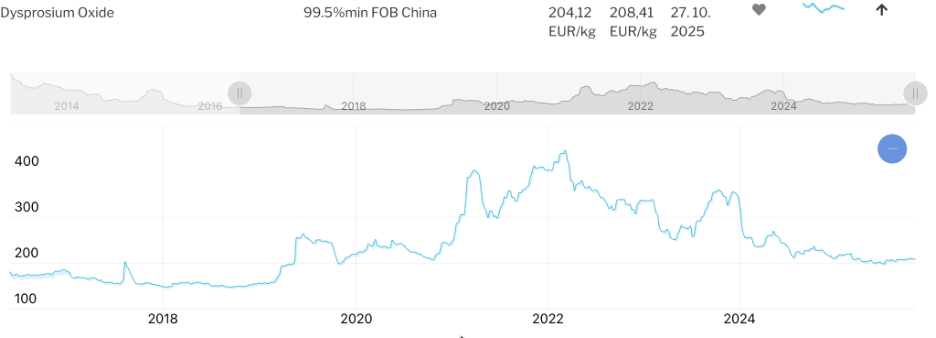
Dysprosium Oxide

A sharp increase in demand for dysprosium since 2020, caused by growth in the production of permanent magnets for wind turbines and electric motors (Source: https://ise-metal-quotes.com/price-logged-in.php).


The escalation reached its peak in September 2025, when China completely banned the export of rare earth elements, explaining simply that “we need them ourselves”.  4

The response came swiftly. President Donald Trump set off on a diplomatic tour of Asia and the Pacific, seeking new alliances across the critical-materials supply chain — from resource-rich Malaysia and Vietnam to industrial powerhouses like Japan and Australia.

His goal is to strengthen the US strategic presence in Southeast Asia through a new form of cooperation that analysts have already dubbed ‘mineral diplomacy.’ 

Seeking to lessen its reliance on supply chains controlled by Beijing, Washington is courting partners with promises of investment, joint ventures, and secure supplies.

The ongoing trip has already resulted in the signing of a number of framework agreements on trade and critical minerals with Cambodia, Thailand, Malaysia, Vietnam and Japan.

In Kuala Lumpur, during the ASEAN summit, the US and Malaysia signed an agreement on the development of supply chains for mineral resources and rare earth elements. Similar documents were signed with Cambodia and Thailand.5

However, the euphoria did not last long. Just a day later, Malaysia's trade minister denied reports that quotas and bans on exports of unprocessed rare metals to the US had been lifted. What exactly the memoranda contain and how they will help Washington circumvent Chinese export barriers remains unclear. 6

Many analysts fear that such tough ‘mineral diplomacy,’ aimed at reducing dependence on China to 25% by 2030, could backfire. Southeast Asian countries, for which China remains the main trading partner, may perceive American pressure as interference in the regional balance and — contrary to Washington's intentions — move even closer to Beijing. 7

Japan occupied a special place on the tour. Prime Minister Sanae Takaichi, who had just taken office, proposed a ‘new golden age of relations’ to Trump, the first step of which was a framework strategic agreement on critical minerals and rare earth elements. 8

At first glance, an alliance with Japan seems strange: the country itself is 80–90% dependent on Chinese supplies of rare earths. But that is precisely why the agreement has symbolic and strategic significance — it creates a ‘mini-alliance on rare metals.’ 9

The document provides for the creation of a joint investment fund, estimated by analysts to be worth up to $5 billion, for the exploration and development of rare earth and lithium deposits in third countries — Australia, Vietnam and Malaysia. 10

The parties also agreed to build new facilities for the separation and purification of rare earth elements in Japan  and the United States. The agreement provides for the removal of export restrictions between the countries, as well as cooperation in research and development (R&D), particularly in technologies for processing heavy rare earths and creating magnetic alloys for high-tech industries. 11 12

A joint investment plan and supply map will be approved within six months. The Japanese JOGMEC (Japan Oil, Gas and Metals National Corporation) and the American Export-Import Bank have been tasked with financing the projects, which will support mining in Australia, Malaysia and Vietnam. 13

The main goal is to bypass dependence on Chinese concentrate and build alternative logistics for the supply of critical materials.

Trump's series of agreements does not solve the problem instantly, but it sets a new architecture for the global market for critical minerals. If the US and its partners succeed in building alternative logistics, dependence on China may indeed be reduced. However, success will depend on how willing Southeast Asia is to accept American leadership without fear of losing economic ties with Beijing.